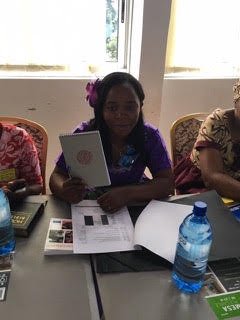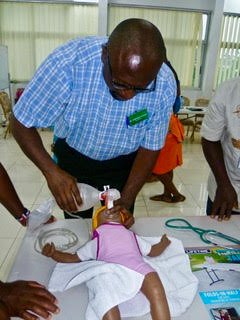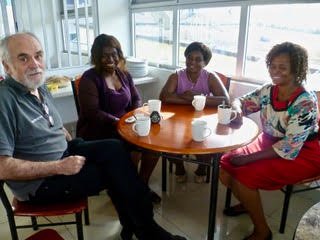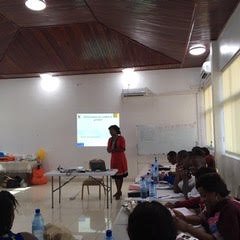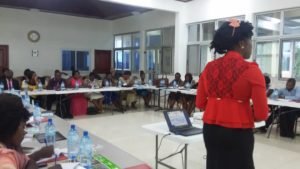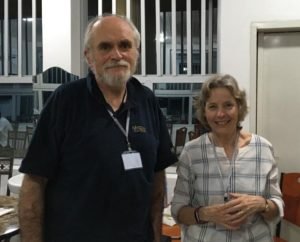
This is Alison and Jarlath, busy in Cameroon mentoring 12 local instructors through their instructor candidate newborn care courses. We use the UK model for training instructors. They first have to do a two day very intense instructor training course known as the generic instructor course (GIC). Then they have to teach on 2 newborn care courses but are supervised during that time by a more senior instructor. At the end of this they are fully fledged newborn care course instructors. It is quite demanding training, the same as the UK advanced life support instructors go through, but is one of the best short instructor training courses available. The NICHE instructors are on site this week to complete the training of the 12 local instructors who did their generic instructor course this time last year. As a team, we are very heartened by this step. It is step 8 in our sustainability plan and means that we can remove ourselves from Cameroon for a few years. Step 9 and 10 will take place when the trained local instructors have done enough courses to start training as instructor trainers themselves. We hope to be invited back for that stage in two or three years time.
Blog
Alison and Jarlath are off to Cameroon again!
Sustainability has nearly been achieved in Cameroon and so it seems fitting that Alison – who set all the wheels in motion with this project in the first place – should be returning for what will probably be the last trip for UK instructors for a while. She and Jarlath, one of the other very senior instructors, are travelling to Yaounde at the end of April to help Grace and the team of Cameroonian instructors with 2 more Newborn Care Courses. Their main role while there will be to mentor the next group of partly trained instructors as they teach on their first 2 courses and become fully fledged instructors in their own right. This will bring to 20 the number of local instructors and renders the project viable without any input from UK instructors.
Business plan for the next couple of years
We have worked out our plan of action for 2019 and 2020. The business plan is available via the “Our Mission” page at https://www.nicheinternational.org.uk/mission/. In short, we intend to do one trip to Cameroon this year to run two Newborn Care Courses and supervise the 12 partially trained local instructors through their first two teaching experiences. When we leave, there will be a faculty of 20 fully trained NCC instructors, many of whom are working in health facilities that the Foreign and Commonwealth Office advises UK personnel not to travel to currently. UK instructors will only need to return to Cameroon to run Generic Instructor Courses (GICs) in the future. We also hope to do 4 trips to Liberia over this period, to train healthcare workers and run two GICs to start developing the local faculty, replicating the model we developed in Cameroon. We have a lot of fundraising to do to realise this business plan. Any help gratefully received! You can donate at https://www.nicheinternational.org.uk/want-to-donate/. Thank you!
How to wake your learners up between lectures – Cameroon style
NICHE International trains local instructors to teach the Newborn Care Course. Here’s a little ice-breaker that I learnt from the lead neonatal nurse of Bamenda Hospital….
Back home again
So we are back home again in the dark, cold UK. I wore the traditional dress I was given by CH Rennie Hospital today to cheer me up and help me wade through the mound of paperwork that awaited me at work.
We had a very successful trip all in all. We trained 26 midwives and neonatal nurses, further honed the course material and made friends with some wonderful people. Working alongside MCAI (www.mcai.org.uk) worked well. They are doing sterling work with extended skills training for midwives as well as supporting the neonatal nurse practitioner programme. Their medical director, Professor David Southall OBE, recently spoke about MCAI’s Liberian task sharing programmes, see https://torquaymedsoc.com/liberia.
Can I practice it single-handed?
Resuscitation of the newborn is all about team work and in the UK we train people as much in how to get the best out of and support their team as we do about what to actually do in a resus situation.

Our Liberian learners have a lot of experience with trying to resuscitate very sick babies. Much sicker than any we see nowadays in the UK thanks to better obstetric care and recognition of fetal distress before the baby is significantly deprived of oxygen. They are used to taking responsibility for these sick babies and their clinical skills are impressive. But when we try to get them to resuscitate in pairs or in threes, they will often ask if they can practice it “alone”. This is because many of our learners are single-handed practitioners in remote communities with no one who will answer their call for help in an emergency situation.


We teach them how to balance the bag on their arm to better facilitate rhythmic chest compressions and breaths for newborns in extremis – I find their earnestness humbling. When have I ever been in an emergency situation without 2 or 3 extra pairs of hands around me?
The 8 “danger signs” in the newborn
We are nearly at the end of our second course here in Liberia. We have 2 doctors who are now helping with the facilitation of the course as well as Kola and Gertrude (one of the new neonatal practitioners). This means that we have time to just sit and listen to some of the sessions which gives us a different perspective. The role of the instructor is such that we facilitate a session, keeping an eye on the time, on our learners’ needs, on whether people can see the slides and hear us etc. and sometimes the actual content sort of passes us by.
One of our workshops is entitled “Recognising serious illness” and we use one of the Global Health Media videos as a teaching and discussion resource. It talks about the 8 “danger signs” and it all makes so much sense. These videos are truly superb. Take a look at https://globalhealthmedia.org/portfolio-items/danger-signs-in-newborns-for-health-workers/?portfolioID=5638. But also look at the other videos on that site that are all free to download. There are videos on caring for the preterm infant, giving an im injection, expressing breast milk, cup feeding and all sorts of other absolute gems. Filming was done in India and Nigeria and the world owes a debt of gratitude to the families who allowed their incredibly sick babies to be filmed and to the health care workers who assessed these babies for us so clearly on film. I shall be using the one on signs of respiratory distress in teaching sessions in the UK: https://globalhealthmedia.org/portfolio-items/breathing-problems/?portfolioID=5638.
The 8 danger signs are as follows:

We have been stressing these “danger signs” during the scenario simulation sessions this afternoon. It certainly helps our learners to concentrate on the things that matter when working through their scenario. They are not used to this type of learning (role play with a manikin and some basic equipment) and tend to stand around the manikin talking rather than doing.

They are getting quite into it now though and I’m looking forward to the final simulation session tomorrow before their exam. Once they get used to it, it becomes quite fun – and quite difficult to control as they all start making up the scenario for their colleagues regardless of what I’m trying to tell them is happening! They are using their own experiences and some of what they are replaying is probably quite cathartic in an environment where a “team debrief” after an unsuccessful resuscitation is pie in the sky.
“Titty water time!”
We teach the Newborn Care Course in different countries of the world and although the language used is English, we do find that some words don’t travel very well. Here in Liberia we have had to change the names of the babies in the case histories because they had a French flavour to them (because of our work in Cameroon) and our Liberian colleagues couldn’t work out how to pronounce “Yves” and “Mireille”. We’ve also changed “cot” to the more American “crib” that they use here and we allow them to talk about “reflex” interchangeably with “tone” when they are assessing the newborn baby. But today’s lexicon stumped us initially until it became clear that “titty water” is in fact breastmilk.
Just about everyone breastfeeds in Liberia. I thought it was because the pregnant women were well educated in the antenatal clinic but it transpires that many women go nowhere near the antenatal clinic. It’s just that formula is expensive. Very few breastfeed exclusively for 6 months as per current WHO advice. World Bank figures for exclusive breastfeeding in babies under 6 months of age for 2013 suggest that 54.58% of these young babies in Liberia are exclusively breastfed (https://tradingeconomics.com/liberia/exclusive-breastfeeding-percent-of-children-under-6-months-wb-data.html). They are given corn cereal mixed with water to supplement the breast milk and sometimes from a very young age.
Early breastfeeding is one of the World Health Organisation’s 4 top priorities for combating high neonatal mortality rates and we talk a lot about supporting breastfeeding mothers during the Newborn Care Course and the importance of feeding expressed breastmilk to the babies on the neonatal units. Our co-instructor, the indomitable advanced neonatal nurse practitioner Kola, pits the mums on his neonatal unit against one another with his 3 hourly cry of “titty water time” when they all have to express 10mls of breastmilk to feed their premature baby down the baby’s nasogastric tube. He says a bit of healthy competition leads to better neonatal outcomes!


We have changed all the “cots” to “cribs” on the Liberian version of the slides this evening but can’t quite bring ourselves to make the required changes to “breastmilk”.
The oxygen concentrator
In the UK, oxygen is piped to our wards and surgical theatres. Resuscitaires (for neonatal resuscitation) take air and O2 cylinders in case babies are delivered in areas where there is no piped O2. But really we only use cylinders nowadays in hospitals in the UK for teaching purposes – most resuscitation teaching rooms don’t have piped oxygen.
The hospital we are in currently in Liberia runs its electricity entirely on generators and only has running water for a few hours a day so it is unlikely to have piped oxygen any time soon. Oxygen has to be concentrated from air. We have a session on the O2 concentrator on day 2 of the Newborn Care Course and it gives the UK instructors’ a chance to take a break and hand over to the local instructors who are absolute whizzes on how these things work and, more importantly, how to maintain them. It is always one of the most popular workshops in the course; many neonatal nurses have one in the corner of their unit but it often doesn’t work because no one knows how to clean the filters, change the water etc. This demonstration can bring 4 or 5 defunct O2 concentrators back to life in one fell swoop!
Here is Kola explaining all about the O2 concentrator in ways which even I could understand for the first time ever. The last photos are of homemade CPAP which he has made from a bottle of mineral water and some oxygen tubing attached to the O2 concentrator. CPAP ensures pressure in the baby’s nose all the time he/she is breathing out as well as in. This prevents the lungs collapsing right down and effectively treats respiratory distress syndrome in the premature babies.


An oxygen concentrator can turn 21% from the air into 70 -90% O2 depending a bit on climatic conditions. WHO has put together a FAQ sheet for people who want to know more at https://www.newbornwhocc.org/ONTOP-DATA/Equipment-PDF/Oxygen-concetrator/FAQ-Oxygen-concentrator.pdf. Kola’s unit, courtesy of MCAI funding, has an O2 splitter which means that 3 babies can receive oxygen from the one concentrator. They rely on electricity to work so health facilities should keep some back up cylinders as well.
Skin to skin mother (and father) care
Keeping babies warm is one of the 4 themes identified by WHO as factors which contribute to bringing down neonatal mortality rates. The mean temperature in Liberia is 27° C (81° F ), with temperatures rarely exceeding 36° C (97° F ) or falling below 20° C (68° F ). But our learners today were telling me about the traditional birth attendants’ habit of holding the baby upside down and slapping its feet as soon as it is born and then washing it in cold water straight away. Mind you, I am not sure it is that long ago that babies in my own country were treated like this.
Benefits of skin-to-skin contact for babies
- Better brain development
- Better emotional development
- Less stress
- Less crying
- Less brain bleeds
- More settled sleep
- Babies are more alert when they are awake
- Babies feel less pain from injections
- The heart rate stabilizes
- The oxygen saturation is more stable
- Fewer apnoea attacks
- Better breathing
- The temperature is most stable on the mother
- Breastfeeding starts more easily
- More breast milk is produced
- Gestation-specific milk is produced.
- Faster weight gain
- Baby can usually go home earlier
- Enables colonisation of the baby’s skin with the mother’s friendly bacteria, thus providing protection against infection (UNICEF Baby Friendly Initiative information)
Benefits of skin-to-skin contact for parents
- Parents become central to the caring team
- Better bonding and interaction with their child
- Emotional healing
- Less guilt
- Parents are calmer
- Parents are empowered and more confident
- Parents are able to learn their baby’s unique cues for hunger
- Parents and baby get more sleep
- Parents (especially mothers), are less depressed
- Cope better in NICU
- See baby as less “abnormal”