Post written by Dr Ajinkya Kale, neonatologist working with the Community Empowerment Lab (CEL), our collaborating partners for a forthcoming project in Uttar Pradesh where neonatal mortality is still more than 30 per 1,000 live births.
… it’s a huge milestone in the village I’ve been going to every week
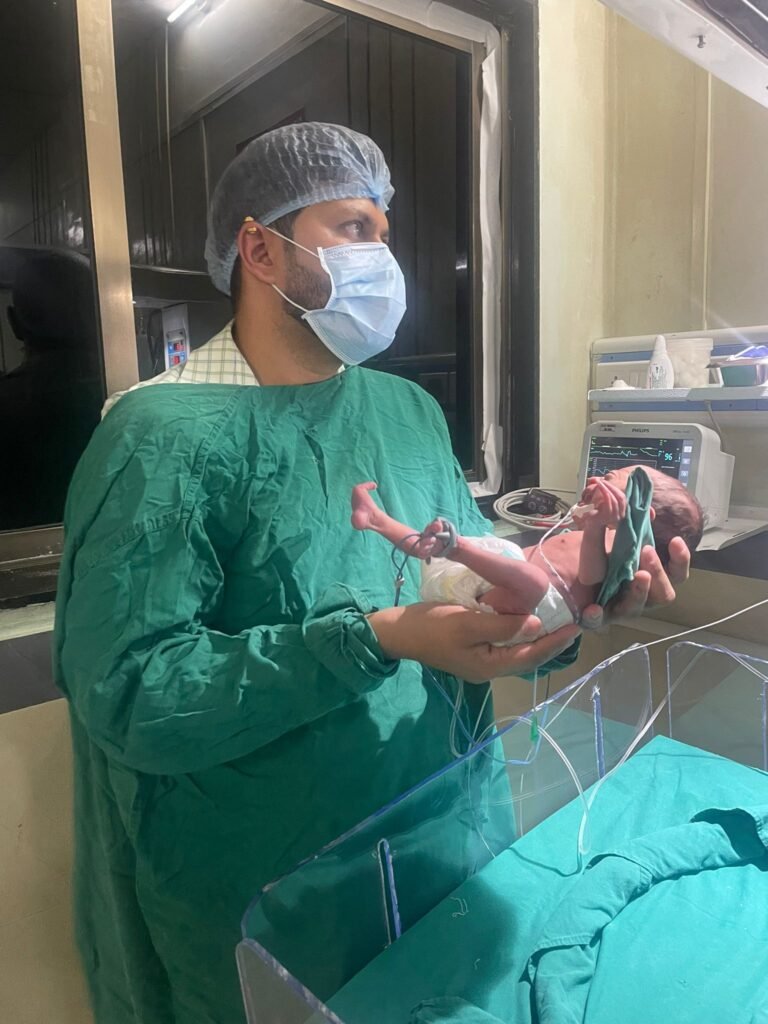
Oh yes—that’s me holding a 28-weeker, now 32 weeks corrected.
A happy, healthy little girl—IVH-free*, antibiotic-free.
It may look like a simple moment, but where I worked, this is nothing short of a quiet miracle. A true achievement for that setup.
Visiting this village every month gives me a stark, humbling reality check—of where half the world truly stands when it comes to resources, funding, and even access to evidence-based knowledge.
So much of what we consider routine in big cities feels almost indulgent here. Money, systems, affordability, safety nets. In places like the NHS, people don’t even think about paying. Care simply exists.
But in Derwan, reality is different.
Here, warmers are shared—two babies under one light—so both can receive phototherapy.
OG* tubes replace umbilical catheters because there is no money.
Feeds are advanced faster than guidelines would allow, not by choice, but by necessity.
Doctors, nurses, and families pray—not quietly, not occasionally—but constantly—that the baby will tolerate feeds, because there’s no money for cannulas, long lines, IV fluids, or second chances.
I consider myself a moderately religious Hindu. I visit temples often.
Yet I have never heard prayers as raw, as desperate, or as united as the ones I hear within these hospital walls.
Here, there are no divisions—no barriers of caste, class, or role. Just parents, doctors, nurses, and babies, all bound by a single shared hope:
A healthy, neurologically intact baby.
It feels surreal every single time.
And somehow, standing here, holding that tiny life, I feel certain—
I am in the right place, in the right mindset, and in the right tone for what lies ahead.
See you very soon.
*IVH intraventricular haemorrhage (bleeds into the brain which can have an effect on a premature baby’s neurodevelopment)
*OG orogastric tube, normally used for feeding babies but in resource poor areas can also be used as a line through a blood vessel in the umbilical cord stump to give intravenous fluids and antibiotics
Ajinkya adds:
“For context, the organisation is working with WHO on a couple of projects, and a few weeks ago WHO abruptly withdrew funding for two of them. The team has been managing the repercussions of that situation.
This is the response I eventually received from the Chief Finance Coordinator:
“We took a sudden hit from WHO actually, Ajinkya, and two years of iKMC funding were unexpectedly withdrawn. We are negotiating for a single site with a very truncated budget—fingers crossed.”
Nevertheless, this should not affect the logistics or implementation of our programme.”
If anyone feels they can help fund this programme, please donate here and send us a message stipulating that the money is to go to the Varanasi project. Thank you very much!
https://nicheinternational.org.uk/want-to-donate/